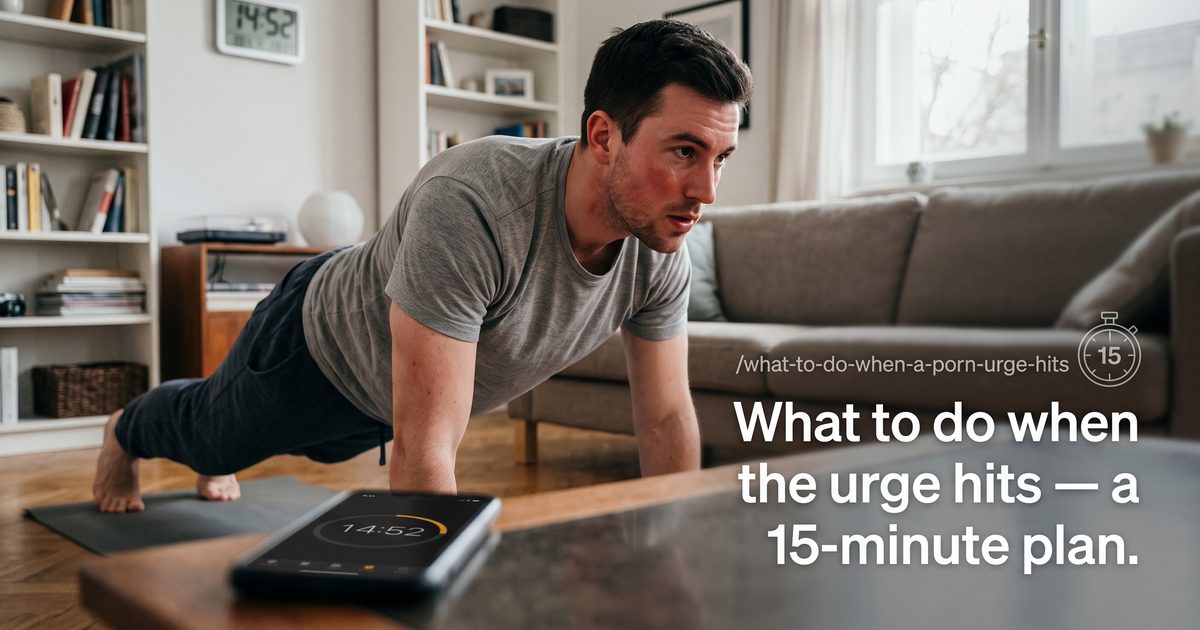
If you're in the middle of an urge right now, skip this article and open the free Crisis Toolkit. It will walk you through the next fifteen minutes step by step, including a guided version of everything on this page. Come back and read the why afterward.
Because one idea changed more for me than almost anything else in recovery: an urge is a wave, and every wave falls.
The lie an urge tells you
In the moment, every urge makes the same claim: I am permanent. I will keep getting stronger until you give in. The only way to make me stop is to feed me. For years I believed that claim, and it made a certain kind of sense. Every time the pressure built, I eventually gave in. The pressure vanished. And the lesson my brain recorded was "acting on it is what ends it."
But that's not what is actually happening. A craving has a shape. It builds, it peaks somewhere around eight to twelve minutes in, and then it drops, whether or not you feed it. The relief you feel after giving in isn't proof the urge had to be obeyed. The wave was going to break anyway. You just never stayed long enough to watch it happen.
An urge is loud, but it can't actually hurt you. Every urge you've ever had has ended, including every one you didn't obey.
What urge surfing is
Urge surfing comes from a kind of therapy called mindfulness-based relapse prevention. The psychologist Alan Marlatt built it for exactly this problem. Instead of fighting the urge, which keeps all your attention locked on it, or obeying it, you do something that sounds almost too simple: you watch it, like a wave you're floating over, until it passes.
That's not passive. It's the hardest fifteen minutes of real work in recovery. And it works for a reason. Every time an urge rises and falls without being fed, the wiring between trigger and habit gets a little weaker. White-knuckling treats every urge like a war. Surfing treats it like weather, and weather passes whether you fight it or not.
How to do it
1. Name it out loud
The moment you notice the pull, say it plainly: "This is an urge." Not "I'm failing." Not "here we go again." Just the fact. Naming it moves you one step back from it. You are the one watching the wave, not the wave itself.
2. Find it in your body
An urge always lives somewhere physical. Chest, stomach, skin, jaw, hands. Find where yours is and describe it to yourself the way you'd describe it to a doctor: tight, warm, buzzing, hollow. This sounds strange, and it's the core of the whole technique. You can't observe a feeling and be swept away by it at the same moment.
3. Breathe through the crest
Slow your breathing. In through the nose for four, hold for four, out for four, hold for four. Your body follows your breath. You're not breathing to make the urge vanish. You're breathing to stay steady while it peaks.
4. Watch it change
Keep checking the feeling every minute or so. Is it stronger? Weaker? Has it moved? I didn't believe this part either, until I did it: the urge changes while you watch it. It almost never holds its peak for more than a few minutes. Somewhere between minute ten and minute twenty, most men notice the grip has loosened. Not from fighting harder. The wave just fell.
5. Close the door behind it
When the wave has passed, do one thing that puts distance between you and the trigger: leave the room, text a friend, step outside. A spent urge can build again if you stand in the same spot staring at the water. This is also the moment an accountability partner is actually for. Contact before and after the wave, not confession after a fall.
What urge surfing is not
It's not a cure, and I'd be lying to you if I sold it as one. Urge surfing gets you through this urge. Recovery is what happens when you stack those moments on top of honesty, community, and dealing with what's underneath the habit: the loneliness, stress, and shame the urge is usually carrying a message about. If you're at the beginning of that longer road, start with what actually happens in the first 14 days. It maps exactly where urge surfing fits.
Let the toolkit walk you through it
The free Crisis Toolkit runs urge surfing for you: a timed wave, box breathing, and grounding, right in your browser. No login, and it works offline once you've opened it.
Open the free Crisis Toolkit