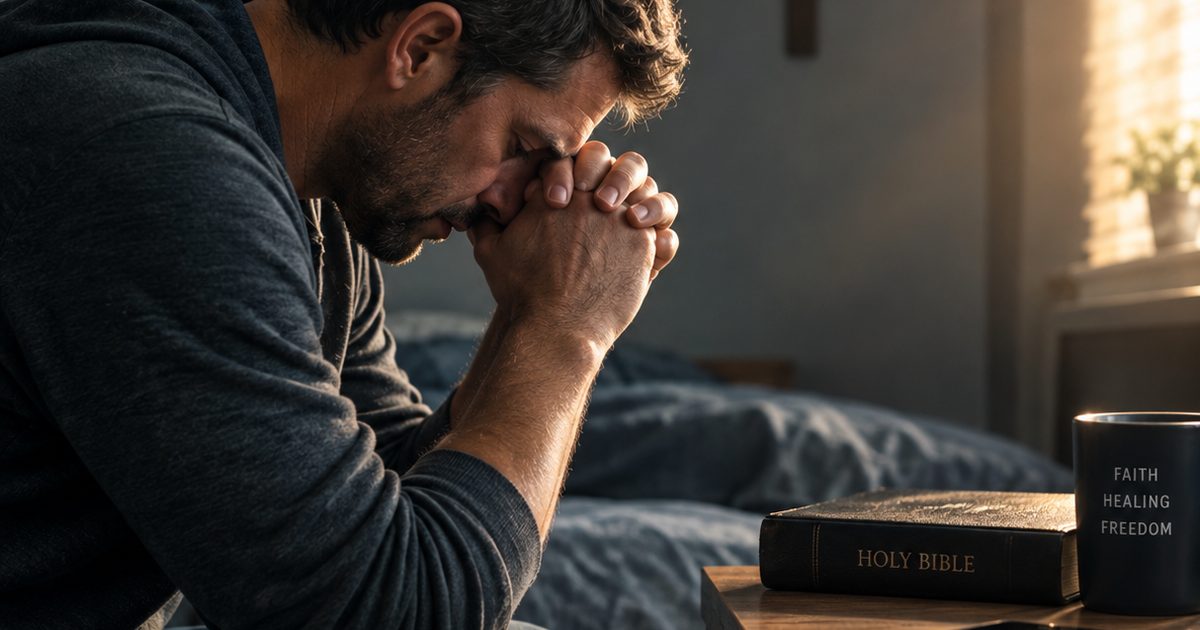
If you're a Christian man with a pornography problem, your last several years probably look a lot like mine did. Sincere prayer, sometimes in tears. Promises to God that you meant completely. Seasons of victory that made you think it was finally over, and falls that felt like they erased all of it. Sitting in church carrying it, certain you were the only man in the room who did.
I did all of that for more than twenty years, holding a real faith the whole time. Here is what I wish someone had told me at year two instead of year twenty: your faith isn't the weak point. The strategy is. You're fighting a two-front war on one front.
Why prayer-plus-willpower keeps not working
Pornography addiction is a spiritual battle. I'll never say otherwise. But it is also a trained habit in the brain: a dopamine loop your mind has run thousands of times, wired to triggers like stress, loneliness, boredom, and a phone in a dark room. The spiritual front and the biological front are both real. Most Christian men fight only the first one, with private prayer and gritted teeth. Then they read every relapse as spiritual failure.
And fighting alone in secret doesn't just leave a front undefended. It feeds the enemy, because secrecy is what this addiction eats. James 5:16 is blunt about this: confess your sins to one another, and pray for one another, that you may be healed. To one another. Not only to God in the dark, where the shame loop never gets broken. I prayed about my addiction for two decades. It started dying the week another human being heard the truth.
Conviction pulls you toward the light. Shame tells you to stay hidden until you're better — which is just the addiction wearing a religious costume.
What the church often gets wrong — and what to do about it
Many of us learned about lust from a youth-group talk that boiled down to "try harder and bounce your eyes." We grew into men whose churches never once made it safe to say "I'm losing this fight." If your church is silent about it, the numbers aren't. Surveys keep finding that most Christian men, including men in ministry, struggle with pornography. The man beside you in the pew is not shocked by your struggle. Odds are he shares it.
That doesn't mean announcing it from the front row. It means refusing to let a culture of silence sentence you to fighting alone. If there's one safe, mature man — a pastor, an elder, a friend who's earned it — start there. If there isn't, start with a Christian recovery group or a counselor. You don't need maximum exposure. You need one crack in the seal.
Where to actually start: four moves
1. Tell one human being the plain truth
Not a cleaned-up version. The plain one. This one step matters more than everything else in recovery combined, and it's the one most men delay for years. I wrote about why the first honest sentence is the hardest one, and why it's worth saying anyway. If the person you eventually need to tell is your wife, that conversation deserves its own care.
2. Get a tool for the moment of the urge
Resolve made on Sunday doesn't survive Tuesday at 11pm without a plan. Learn urge surfing, a way to ride out a craving without feeding it. Or use our free Crisis Toolkit, which walks you through it live, with a faith mode that puts scripture in front of you at the exact minutes the craving peaks.
3. Make the path harder and the exit easier
Filters and accountability software won't cure you. Nothing external will. But every step you put between yourself and a fall slows you down long enough for the wave to pass, and for grace to get a word in. Phone out of the bedroom. Filters on by default. And a real accountability partner, which is a relationship, not an app report.
4. Expect a road, not a moment
Some men are delivered in a moment. Most of us are healed on a road — one with a hard first two weeks, a gray, flat stretch, real setbacks, and a God who is not surprised by any of it. The men who get home are the ones who stopped hiding, stumbles and all.
Start with the free book
The Hidden Life is a free ebook written for exactly this fight — the shame cycle, what keeps the secret alive, and a Christian man's honest road toward freedom. No cost, no account.
Get The Hidden Life — free